
Government Schemes for Girls Education in India: Eligibility, Benefits and How to Apply
Table of Contents
Education can help girls become financially independent, develop professional skills and build a better future. However, many families struggle with school fees, college expenses, books, transport and hostel costs. Government scholarships and education-support programmes can help eligible students continue their studies.
Several government schemes for girls education are available in India. Some are specifically designed for female students, while others support eligible students of all genders and reserve a share of scholarships for girls. The benefits may depend on the student’s class, course, academic performance, family income, state and other eligibility conditions.
This guide explains important government schemes for girls education, including the AICTE Pragati Scholarship, the UGC Indira Gandhi Scholarship for Single Girl Child, CBSE’s Single Girl Child Merit Scholarship and selected state-level programmes. It also explains where to find official information, which documents may be required and how to apply.
Before applying, remember that a scholarship is not guaranteed simply because a student is a girl. Every scheme has its own eligibility rules and application process.
What Are Government Schemes for Girls Education?
Government schemes for girls education are programmes intended to reduce financial barriers and encourage girls to continue studying. Depending on the programme, support may include scholarship payments, educational incentives or assistance for approved study-related expenses.
Some programmes support girls during school, while others help them pursue engineering, technical diplomas, undergraduate degrees or postgraduate courses. Certain state schemes also encourage school attendance and aim to reduce early marriage.
The most suitable government schemes for girls education depend on the student’s present education level and circumstances. For example, a student entering Class 11 may be eligible for a different programme from a girl starting an engineering degree or a single girl child entering postgraduate studies.
Students should check the latest official notification before relying on any advertised amount or deadline. Application dates and conditions can change from one academic year to another.
1. AICTE Pragati Scholarship for Girl Students
The Pragati Scholarship is a central government scholarship administered by the All India Council for Technical Education (AICTE), under the Ministry of Education. It aims to encourage girls to pursue technical education.
This programme is relevant to eligible students entering approved technical diploma or degree courses. It is one of the government schemes for girls education to consider after Class 10 or Class 12, depending on the course and admission route.
Eligibility
The published scheme conditions include:
- The applicant must be a girl student.
- She must be admitted to an eligible technical diploma or degree programme at an AICTE-approved institution.
- Applicants must meet the admission-year requirements, including the rules for first-year admission or second-year lateral entry.
- Family income must satisfy the applicable scheme limit.
- The student must meet the other requirements in the current official guidelines.
The MyScheme listing specifies a family-income ceiling of ₹8 lakh per year and says that a maximum of two girl children per family may be eligible. Students must check the current scheme rules, because the eligible institutions and admission conditions matter.
Scholarship benefit
The published Pragati Scholarship description provides assistance of ₹50,000 per annum for eligible students, subject to the scheme’s conditions and maximum duration. The assistance is intended to support education-related needs such as fees, books, stationery, equipment and other permitted expenses.
How to apply
Visit the official National Scholarship Portal and find the AICTE Pragati Scholarship for the relevant course. Read the eligibility details, confirm your institution and follow the current application instructions.
For 2026–27, the portal lists Pragati degree and diploma scholarships with a student application deadline of 31 October 2026. Confirm the date on the scheme listing before submitting, as dates may be updated.
2. UGC Indira Gandhi Scholarship for Single Girl Child
The Post-Graduate Indira Gandhi Scholarship for Single Girl Child is offered through the University Grants Commission (UGC). It is designed to support eligible single girl children who are entering postgraduate studies.
This is one of the government schemes for girls education specifically relevant to students who have completed a bachelor’s degree and are beginning a master’s programme.
Eligibility
The UGC’s published scheme information states that:
- The applicant must qualify as a single girl child under the scheme’s definition.
- She must be admitted to the first year of a regular, full-time master’s degree course.
- The university or postgraduate college must be recognised.
- The applicant must be up to 30 years old at the time of admission.
- Distance-education postgraduate courses are not covered under the published eligibility description.
Read the full scheme guidelines to understand the definition of a single girl child and any additional conditions.
Financial assistance
The UGC scheme page lists financial assistance of ₹36,200 per year for a tenure of two years. Applicants should confirm the current application route, selection process and scheme details before applying.
How to apply
Start with the official UGC scholarship page. Follow the application instructions shown there and check whether applications for the relevant academic year are open.
Students should not assume that the scholarship is automatically awarded to every single girl child entering postgraduate education. Selection and eligibility requirements still apply.
3. CBSE Merit Scholarship Scheme for Single Girl Child
The CBSE Merit Scholarship Scheme for Single Girl Child is intended to encourage meritorious students who are the only child of their parents to continue school education.
This programme is different from the UGC postgraduate scholarship. It is aimed at eligible students who have passed the CBSE Class 10 examination and are continuing their studies in Classes 11 and 12.
Eligibility
The published MyScheme information includes the following conditions:
- The applicant must be an Indian national.
- She must be the only child of her parents under the scheme’s definition.
- She must have passed the CBSE Class 10 examination with at least 60% marks.
- She must continue studying in Class 11 and Class 12.
- The school and tuition fee must meet the scheme’s prescribed conditions.
Students should read the current CBSE notification to confirm the latest requirements and application dates.
Scholarship amount
The published scheme description lists a scholarship of ₹500 per month for a maximum period of two years, subject to the applicable rules.
Application process
Check the official CBSE website for the current Single Girl Child Merit Scholarship notification and application instructions. Follow the prescribed process and ensure that the school and student details are correct.
For families looking into government schemes for girls education immediately after Class 10, this scholarship may be relevant if the student meets the CBSE-specific conditions.
4. Kanyashree Prakalpa — West Bengal
Kanyashree Prakalpa is a West Bengal government programme designed to encourage girls to continue education and delay marriage. It provides conditional financial incentives to eligible beneficiaries.
It is especially relevant for families in West Bengal researching government schemes for girls education at the school and adolescent stages.
Eligibility and benefits
The official Kanyashree information describes two main benefits:
- Annual incentive: For eligible girls generally aged 13 to 18 who are enrolled in education and satisfy the scheme’s conditions.
- One-time grant: For eligible girls aged 18 to 19 who continue an approved educational or occupational pursuit and meet the requirements.
The official portal lists an annual incentive of ₹1,000 and a one-time grant of ₹25,000. The scheme includes conditions related to residence, age, enrolment and unmarried status, as well as income criteria and specified exceptions.
How to apply
Visit the official Kanyashree portal and contact the student’s school or college for the correct application procedure. The institution can explain which form and documents are needed and how verification works.
Kanyashree is a state-specific programme. Students living in another state should look for the schemes available to them rather than assuming that they can apply for a West Bengal benefit.
5. Swami Vivekananda Merit-cum-Means Scholarship — West Bengal
The Swami Vivekananda Merit-cum-Means Scholarship (SVMCM) supports eligible students from West Bengal who meet the scheme’s academic and family-income requirements.
It is not exclusively for girls, but eligible female students can apply. It may be relevant to school students, undergraduate students and postgraduate students, depending on the course and the applicable scheme rules.
Who can apply?
The requirements vary by education level. Students generally need to meet the prescribed academic performance, income, course and institution conditions. The official SVMCM portal lists a family-income ceiling of ₹2.5 lakh per year, subject to the scheme’s published provisions and exceptions.
How to apply
Visit the official SVMCM portal and select the appropriate course category. Read the current instructions, prepare your academic records and income documents, and complete the application as directed.
Among government schemes for girls education in West Bengal, SVMCM is an option for eligible students who meet its merit-cum-means requirements. Approval is subject to the official process.
6. Central Sector Scheme of Scholarship for College and University Students
The Central Sector Scheme of Scholarship for College and University Students (CSSS), also referred to as PM-USP CSSS, supports eligible students pursuing higher education.
It is not a girls-only scholarship. However, government information has stated that 50% of the scholarships are earmarked for female students. Applicants must still meet the academic, income and other conditions.
Who should check this scheme?
Students who have completed higher secondary education and are entering college may wish to check the current guidelines. Eligibility can depend on merit, family income, regular enrolment and other scholarship restrictions.
How to apply
Check the relevant scheme listing on the National Scholarship Portal. Review the current application category and confirm whether fresh or renewal applications are open.
This scheme can be considered alongside other government schemes for girls education, but students should compare the eligibility rules carefully and check whether receiving another scholarship affects their application.
7. National Means-cum-Merit Scholarship Scheme
The National Means-cum-Merit Scholarship Scheme (NMMSS) is intended to support eligible students from economically weaker families and help them continue their education at the secondary level.
It is not limited to girls. Eligible female students can apply if they satisfy the prescribed academic, income and other requirements.
Students should check the current guidelines for the relevant class, selection examination, income criteria and renewal conditions. The application process may involve state-level procedures, so the student’s school or education department can help explain the steps.
Families researching government schemes for girls education at school level should consider NMMSS if the student meets the conditions. The scheme should not be confused with a scholarship that is exclusively for female students.
8. Post Matric Scholarship for Eligible Girl Students
Post-matric scholarships may help eligible students continue education after Class 10. Different schemes are available for notified categories and other eligible groups, depending on the state and administering department.
A girl may qualify if she meets the particular scholarship’s requirements relating to category, family income, course, institution and domicile. The benefit and permitted expenses vary between schemes.
Read our guide on Post Matric Scholarship: Eligibility, Documents and How to Apply for an explanation of the general process.
Students can also check the National Scholarship Portal and the relevant state scholarship website. These government schemes for girls education can be useful for eligible students pursuing higher secondary, diploma, undergraduate or postgraduate studies.
9. Other State Government Schemes
State governments may provide scholarships or educational incentives based on merit, income, residence, social category or other criteria. These schemes may be available only to students who satisfy the state’s domicile or residence requirements.
For example, Madhya Pradesh operates the Ladli Laxmi Yojana, which includes education-related benefits for eligible beneficiaries at specified stages. Students should check the official state information to confirm the current conditions and payment structure.
Girls and families should visit their state’s official education, social welfare, women and child development, or scholarship department website. Do not rely on an old list without confirming whether a scheme is active and accepting applications.
When comparing government schemes for girls education, always confirm the state requirement, eligible education level, family-income limit and application method before preparing documents.
How to Apply for Government Schemes for Girls Education
The application process differs by scheme, but the following steps provide a practical starting point.
Step 1: Identify the right scheme
Start by identifying the student’s current class or course, age, state, academic record and family circumstances. A school scholarship may not be appropriate for a postgraduate student, while a technical scholarship may only cover approved diploma or degree courses.
Step 2: Check the official guidelines
Read the scheme’s eligibility requirements, benefit details, application dates and restrictions. Confirm whether the programme is open for fresh applications or renewals.
Step 3: Visit the official portal
For central scholarships listed there, visit the National Scholarship Portal. For a state scheme, use the official state portal. Some programmes use separate application systems, so follow the instructions published by the administering authority.
Step 4: Register and complete the form
Enter the student’s name, date of birth, education details, institution information and other requested information accurately. Ensure that the details match the supporting documents.
Step 5: Upload the documents
Upload clear, readable documents in the file format and size accepted by the portal. Do not upload false or altered certificates.
Step 6: Submit and save the acknowledgement
Review the application carefully before submitting it. Save the application number or acknowledgement for future tracking.
Step 7: Complete verification
Some scholarships require verification by the school, college or government authority. Check the portal for pending tasks and contact the institution if verification has not been completed.
Step 8: Track the status
Use the official portal’s status section to check whether the application is pending, requires correction, has been approved or is being processed for payment.
The government schemes for girls education application process may include several stages, so students should not assume that submission alone confirms approval.
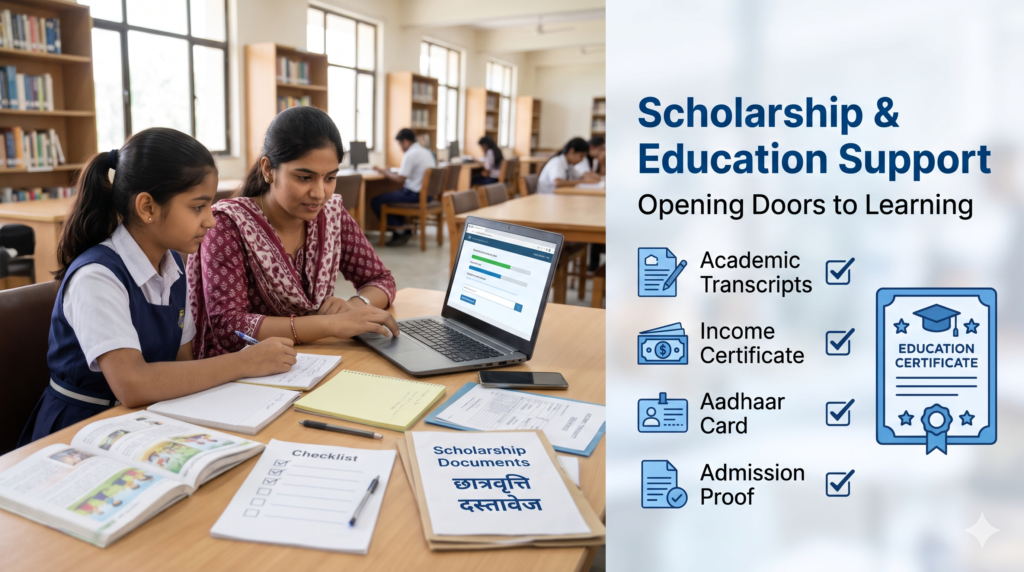
Documents Commonly Required
The exact document list depends on the scheme. Applicants may be asked for:
- Aadhaar or another accepted identity document.
- Recent photograph.
- Previous examination marksheet.
- Current admission or enrolment certificate.
- School or college details.
- Income certificate, where required.
- Domicile or residence certificate, where required.
- Caste or category certificate, where applicable.
- Bank account details in the required format.
- Fee receipt or fee structure, where requested.
- Single girl child declaration or other specific certificate, where required.
- Other documents specified in the official guidelines.
Not every applicant needs every document. For example, a scholarship for a single girl child may require a declaration that is not required for another programme. Check the form before uploading anything.
If an income certificate is required, read our guide on Income Certificate Online Apply. Students should also confirm which issuing authority and certificate format their scholarship accepts.
Common Mistakes to Avoid
Students applying under government schemes for girls education should avoid these common mistakes:
- Applying for a scholarship that does not cover their course or education level.
- Assuming that every scheme is available in every state.
- Using outdated information about deadlines or benefit amounts.
- Entering names, dates of birth or bank details incorrectly.
- Uploading unclear or incomplete documents.
- Ignoring school or college verification.
- Failing to submit a renewal application when required.
- Assuming that two scholarships can always be received together.
- Paying unauthorised agents who promise guaranteed approval.
If an application is marked defective or rejected, read the official reason and follow the correction or grievance process if one is available. Do not submit false information to qualify for a benefit.
How to Check Scholarship Status
After applying, sign in to the official portal where the application was submitted. Open the status or tracking section and enter the required application details.
Check whether the application is awaiting institutional verification, requires correction, has been approved or is undergoing payment processing. The exact status labels differ between portals.
If your application is pending with the school or college, contact its scholarship office. If it is pending with a government department, use the official contact or grievance process shown on the portal.
Never share your password or one-time password with anyone claiming they can release scholarship funds. The government schemes for girls education follow official verification procedures, and no unauthorised person can guarantee approval.
Important Tips for Students and Parents
Before applying, make sure the scheme is suitable for the student’s current education level. Keep digital copies of all documents and save the acknowledgement after submitting the application.
Check application dates regularly, particularly when a portal shows a deadline for the current academic year. For the 2026–27 cycle, the National Scholarship Portal lists several schemes with a student application deadline of 31 October 2026. Deadlines vary by scheme and can change, so verify the date on the specific listing before applying.
Parents and students should also compare the rules for overlapping scholarships. Some schemes restrict receiving another scholarship or stipend at the same time, while other arrangements may be allowed under specified conditions.
The government schemes for girls education can provide useful support, but applicants must satisfy the official requirements. Avoid relying on unverified social media posts or claims that every girl is entitled to a fixed payment.
Frequently Asked Questions
1. Which government schemes are available for girls education in India?
Options include AICTE Pragati, the UGC Indira Gandhi Scholarship for Single Girl Child, the CBSE Single Girl Child Merit Scholarship, Kanyashree Prakalpa in West Bengal and other central or state scholarships. Eligibility differs by scheme.
2. Is there a scholarship only for girls?
Yes. AICTE Pragati and the UGC postgraduate scholarship for single girl children specifically target eligible female students. Other programmes are open to eligible students more broadly but may reserve a share of scholarships for girls.
3. Can girls apply for scholarships after Class 12?
Yes. Depending on eligibility, students may consider technical scholarships, college scholarships, post-matric schemes and other programmes for higher education.
4. How can I apply for a girls’ scholarship online?
Identify the correct scheme, read the official guidelines, visit the authorised portal, complete the form, upload the required documents and finish any verification steps.
5. Can a student receive two government scholarships?
It depends on the scheme rules. Some programmes restrict overlapping benefits. Students should read the guidelines and disclose other assistance when required.
6. Are the same schemes available in every state?
No. Some are central schemes, while others are state-specific and require residence or domicile in that state. Always check the official eligibility criteria.
7. How do I check whether applications are open?
Visit the official scholarship portal or the administering department’s website. Check the academic year, application dates and whether fresh or renewal applications are being accepted.
8. Does submitting an application guarantee scholarship money?
No. The application must satisfy eligibility, document and verification requirements. Approval and payment depend on the applicable scheme rules and official process.
Conclusion
Government schemes for girls education can help eligible students continue their studies from school through technical, undergraduate and postgraduate courses. Some programmes specifically support female students, while others offer opportunities to all eligible students with provisions for girls.
The right scheme depends on the student’s education level, academic record, family income, state and other eligibility requirements. Start with official sources, prepare the required documents and submit the application within the notified period.
Adhikar Kendra is an independent information website, not a government department. It provides general guidance and cannot approve scholarships or guarantee payments. Always confirm the latest eligibility rules, benefit details and application dates on the relevant official portal.