
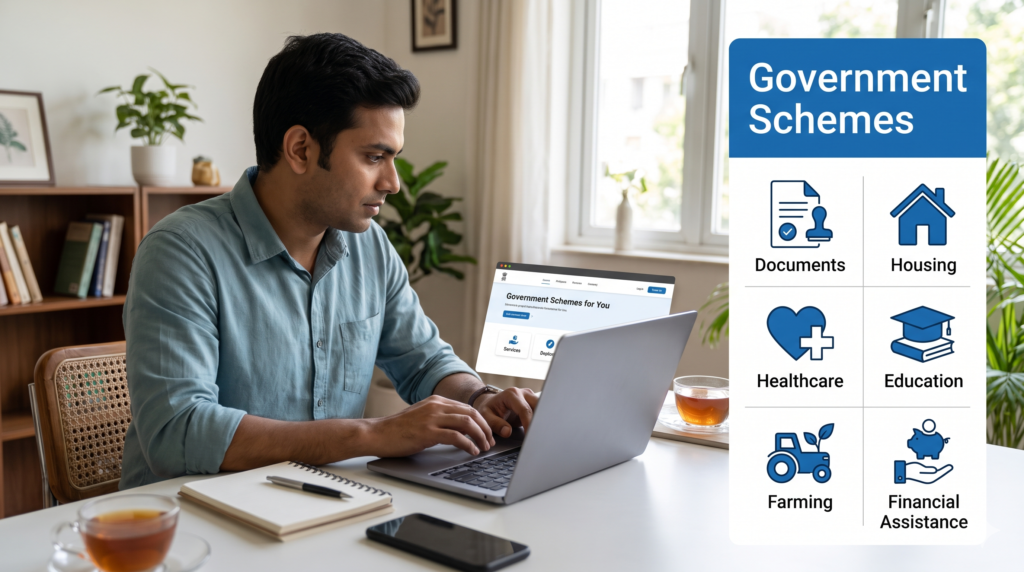
How to Check Your Eligibility for Government Schemes Online in India
Table of Contents
Many people in India miss useful government benefits because they do not know which schemes are available to them or how to check the eligibility rules. A farmer may qualify for agricultural assistance, a family may be eligible for housing support, and a small business owner may find a suitable loan scheme. However, each programme has its own conditions.
The good news is that you can start checking government scheme eligibility online without visiting several offices. The official myScheme portal helps citizens discover schemes based on their personal details and explore the next steps for applying. You can also use the National Portal of India to find scheme information and relevant government services.
This guide explains how to check government scheme eligibility, what information you may need, how to verify the results, and what to do before submitting an application. It is written for first-time applicants, students, farmers, workers, women, senior citizens, families, and small business owners.
What Does Government Scheme Eligibility Mean?
Government scheme eligibility means the conditions a person or household must meet to qualify for a particular government programme. These conditions vary according to the purpose of the scheme and the department that operates it.
For example, a scheme may be intended for farmers, while another may support students, women, senior citizens, construction workers, or small business owners. Some programmes consider household income, age, location, occupation, social category, disability status, or other factors.
When you check government scheme eligibility, do not look only at the scheme’s name or advertised benefits. Read the complete conditions to understand who can apply and what proof is required.
Depending on the scheme, eligibility may involve:
- Age and citizenship or residence requirements.
- Annual family income or income limits.
- Occupation, employment, or business activity.
- Rural or urban residence.
- Land ownership, housing status, or other assets.
- Educational qualifications or current course enrolment.
- Social category or disability-related conditions, where applicable.
- Existing benefits received from another programme.
- Bank account, identity, or other documentation requirements.
Not every scheme uses all these conditions. The official guidelines for the specific scheme are the final reference.
Which Official Website Can You Use to Check Government Scheme Eligibility?
The best starting point for discovering schemes across different departments is the official myScheme platform.
1. myScheme portal
Website: https://www.myscheme.gov.in/
myScheme is a government platform designed to help people discover relevant schemes based on personal details. It provides information about scheme eligibility, benefits, application procedures, and required documents.
You can use the platform to explore available Central Government and State or Union Territory schemes. It is useful when you do not know the exact name of the programme you may qualify for.
If you want to check government scheme eligibility but are unsure where to begin, open the website and look for the option to find schemes for you.
2. National Portal of India
Website: https://www.india.gov.in/
The National Portal of India provides access to government scheme information and includes a personalised scheme-discovery option. You can explore programmes by category and look for information about eligibility and application processes.
This portal is another useful starting point for checking government scheme eligibility, especially if you want to browse government programmes by subject.
3. The relevant scheme’s official website
A scheme-discovery portal helps you identify possible matches. Before applying, visit the official website of the department responsible for the scheme.
For example, a farmer checking a payment-related scheme should confirm the latest information on the relevant agriculture department portal. A person interested in housing support should read the applicable housing programme’s rules.
This final verification is important because government scheme eligibility can depend on detailed rules that differ between programmes, states, and application periods.
Step-by-Step: How to Check Government Scheme Eligibility Online
Follow these steps to find schemes that may match your circumstances.
Step 1: Open the official myScheme website
Visit myScheme.gov.in using your mobile phone, tablet, or computer. Check that the website address is correct before entering any personal information.
Avoid sponsored advertisements or unfamiliar websites that claim to provide guaranteed government benefits. Start with the official portal whenever possible.
Step 2: Select the scheme-finding option
Look for the option labelled “Find Schemes for You” or the equivalent scheme-discovery feature. The layout may change over time, so follow the current instructions displayed on the website.
This feature is designed to help users identify programmes relevant to their profiles. It can be a practical first step when you need to check government scheme eligibility but do not know which schemes to search for.
Step 3: Enter the requested personal details
The portal may ask questions about your age, gender, state, location, income, occupation, education, marital status, or other characteristics. The exact questions depend on the feature being used.
Answer truthfully and select the most accurate available options. Incorrect information may produce irrelevant results or cause you to overlook a suitable scheme.
When checking government scheme eligibility, do not guess your annual income or select an occupation simply because it appears more likely to qualify. Use information you can verify.
Step 4: Submit the questionnaire
After completing the required fields, follow the on-screen instructions to continue. The platform may ask additional questions before showing matching schemes.
Read each question carefully. If a field is unclear, check the portal’s help information rather than entering random answers.
The purpose of this process is to narrow down the options and make government scheme eligibility easier to investigate.
Step 5: Review the matching schemes
Check the results displayed by the portal. Open each relevant scheme to learn about its purpose, benefits, eligibility conditions, and application process.
Do not assume that every result represents final approval. A matching result is a starting point for further verification, not necessarily an official decision that you will receive benefits.
Use the results to organise your search for government scheme eligibility according to your actual needs.
Step 6: Open the detailed scheme information
Select a scheme that seems relevant and read its full details. Look for sections explaining who can apply, who cannot apply, what documents are required, and which authority accepts applications.
If the scheme links to a separate department portal, follow that link only after checking that it is an official government website.
Step 7: Confirm the latest rules
Before applying, check the latest official guidelines, notifications, and application instructions. Conditions may change, and a scheme may have different rules for different categories or locations.
If the details are unclear, contact the responsible department or an authorised service centre. This is especially important when government scheme eligibility depends on income limits, land records, residence, or other formal documents.
Step 8: Apply through the authorised channel
If you appear to meet the criteria, follow the official application process. Depending on the scheme, you may apply online, visit an authorised service centre, or submit documents through a designated office.
Keep your application number, acknowledgement, or receipt where provided. You may need it later to track your application.
Remember that checking government scheme eligibility is only one part of the process. The department may still need to verify your documents and other details before making a decision.
What Information Should You Keep Ready?
You do not necessarily need every document just to explore schemes. However, having basic information ready makes it easier to compare your circumstances with the eligibility rules.
| Information or document | Why it may be needed |
|---|---|
| Age or date of birth | Some schemes have minimum or maximum age limits. |
| State and district | Certain programmes are limited to specific locations. |
| Family income details | Some schemes set household income limits. |
| Occupation details | Benefits may be intended for particular workers or professions. |
| Aadhaar or another accepted identity document | A scheme may require identity verification, subject to its rules. |
| Bank account details | Some benefits are paid through a bank account. |
| Residence proof | The department may need to verify your address. |
| Income certificate | Required where the scheme specifies formal income proof. |
| Caste or disability certificate | Relevant only where the scheme requires it. |
| Land, education, or business records | May be required for agriculture, scholarship, or enterprise schemes. |
The required documents depend on the particular programme. Do not obtain certificates or share identity information unnecessarily before reading the official requirements.
When checking government scheme eligibility, distinguish between information used to find a scheme and documents formally required to submit an application. These are not always the same.
How to Check Eligibility for Different Types of Government Schemes
Different programmes serve different groups. The following examples can help you decide where to start your search.
Farmers and agricultural households
Farmers may explore schemes related to agricultural support, insurance, equipment, irrigation, or other services. Eligibility may depend on the scheme’s definition of a beneficiary, land records, cultivation details, state rules, or other conditions.
If you are interested in the PM-Kisan programme, read our guide on how to check PM-Kisan Samman Nidhi status. For your own government scheme eligibility, confirm the latest rules and beneficiary information on the official PM-Kisan website before taking action.
Families looking for housing assistance
Housing programmes may have conditions concerning household housing status, income, location, beneficiary categories, and previous assistance. The exact requirements depend on the programme and whether it applies to rural or urban households.
Read our guide to PM Awas Yojana 2026 for an introduction to the topic. Then confirm government scheme eligibilityagainst the current official guidelines for the relevant housing programme.
People looking for health coverage
Some government health programmes provide coverage or other healthcare benefits to eligible groups. However, eligibility is scheme-specific and may depend on the programme’s beneficiary identification rules.
You can read our guide to Ayushman Bharat Card eligibility, benefits, and application. For government scheme eligibilityrelating to health coverage, verify your status using the authorised scheme channel rather than assuming that everyone can enrol under the same conditions.
Artisans and traditional workers
Artisans and craftspeople may be interested in programmes that support traditional trades, skills, training, tools, or credit. Such programmes may have occupation-specific and registration-related conditions.
Our PM Vishwakarma Yojana guide explains the topic in more detail. Check government scheme eligibility using the latest official scheme rules, particularly where trade eligibility or existing benefits may affect an application.
Women and families seeking LPG connections
Some schemes support eligible households with LPG connections or related assistance. Conditions may include household circumstances, existing connections, documentation, and other scheme-specific rules.
You can explore our guide to PM Ujjwala Yojana and LPG connection applications. To check government scheme eligibility, confirm the current requirements through the authorised scheme or LPG provider’s official channel.
Small business owners and self-employed people
Entrepreneurs and small business owners may explore schemes involving credit, skill development, training, or business support. The requirements can depend on the business activity, loan purpose, lender assessment, documents, and applicable programme rules.
Our guide to PM Mudra Yojana small business loans is a useful starting point. Before applying, confirm government scheme eligibility and any lending conditions with the relevant official institution or participating lender.
People planning for retirement
Some programmes provide pension-related support to eligible groups. Age, occupation, income, contribution history, and other conditions can differ significantly between pension schemes.
You can read our guide to Atal Pension Yojana eligibility for scheme-specific information. If you are exploring pension support, use the official rules to check government scheme eligibility before opening an account or making contributions.
Why Might You Not See a Scheme in Your Results?
Not seeing a scheme in your personalised results does not always mean you are ineligible. There may be several reasons.
- Your profile details may be incomplete. Missing information can affect which schemes appear.
- The scheme may not be covered by the particular search feature. Some programmes may require a separate search on the department website.
- The programme may be limited to a particular state or district. Location can matter.
- Your answers may not match the scheme’s listed criteria. Check whether you selected the correct income, occupation, or other details.
- The programme may have additional conditions. A basic profile match may not cover every detailed rule.
- The application process may be handled separately. Some schemes direct users to a department or authorised service portal.
If you cannot find a suitable option, search the official scheme directory by category or contact the responsible department. Repeat your government scheme eligibility check after correcting any inaccurate profile details.
Common Mistakes to Avoid When Checking Eligibility
A few simple precautions can help you avoid wasted time and misleading information.
Do not rely on social media posts alone. A video or message may describe an old version of a scheme, omit restrictions, or contain an incorrect application link. Verify government scheme eligibility using official information.
Do not confuse eligibility with approval. Even if you appear to meet the conditions, the department may need to verify your documents or confirm other requirements.
Do not assume every scheme is available nationwide. State schemes and some local programmes may apply only to residents of specific areas.
Do not pay an unofficial agent for a guaranteed benefit. No one should promise approval merely because you have checked your details online. Use authorised application channels and ask for an official receipt for any legitimate fee that applies.
Do not submit false information. Incorrect declarations can lead to rejection, cancellation, recovery of benefits, or other consequences under the applicable rules.
Do not use an outdated checklist. Document requirements, forms, and instructions can change. Confirm the latest version before submitting your application.
How to Stay Safe While Checking Government Schemes Online
Online services can save time, but applicants should protect their personal information.
- Check the website address carefully and use official government portals or authorised service channels.
- Do not share passwords, PINs, or one-time passwords with callers or unknown agents.
- Avoid uploading identity documents to unfamiliar websites that promise instant scheme approval.
- Do not install unknown applications or grant remote access to someone claiming to help with a government benefit.
- Read the privacy notice and check why a website is requesting particular information.
- Keep copies of submitted documents and application acknowledgements in a safe place.
- If someone demands money in exchange for guaranteed approval, verify the claim directly with the responsible department.
When checking government scheme eligibility, provide only the information needed for the service you are using. A genuine scheme may require identity or financial details at a particular stage, but you should confirm the requirement through the official channel before sharing them.
What Should You Do After Finding a Scheme You May Qualify For?
Once you identify a possible match, follow a careful process rather than applying immediately.
First, read the scheme’s full eligibility conditions. Next, make a list of the documents required and check whether your details match the information on those documents. If you need an income, residence, caste, disability, or other certificate, follow the relevant authorised process.
Then review the application instructions. Check whether online registration is available, whether a service centre is required, and whether there is a deadline or another time-related condition. Do not assume that every scheme has the same application method.
Submit accurate information and save the acknowledgement if one is issued. Use the official tracking facility, where available, to follow the application. If the department requests additional documents, respond through its authorised channel.
A careful government scheme eligibility check can help you choose relevant programmes and prepare before applying. It cannot guarantee that a department will approve your application or that funds will be released.
Can You Check Government Scheme Eligibility Without Visiting an Office?
In many cases, you can begin online. The myScheme portal and the National Portal of India provide online scheme-discovery features, allowing users to explore relevant programmes from home.
However, the complete process varies. A scheme may require an online form, in-person verification, original documents, a visit to an authorised service centre, or confirmation from a local authority. Some users may also need help accessing digital services.
If you do not have reliable internet access, ask an authorised Common Service Centre or the relevant government department about available assistance. Before sharing documents, confirm that the centre is authorised to help with the particular service.
Online discovery makes government scheme eligibility easier to explore, but it does not eliminate every offline requirement.
Final Checklist Before You Apply
Use this checklist before submitting an application:
- I have identified the official scheme website.
- I have read the latest eligibility conditions.
- I have checked age, income, occupation, and location requirements where applicable.
- I have confirmed which documents are required.
- My application details match my supporting documents.
- I understand whether an online or offline process is required.
- I have checked any deadline or other time-related condition.
- I am using an authorised application channel.
- I will save the acknowledgement or reference number if provided.
Completing this checklist will help you make a more informed government scheme eligibility assessment and reduce avoidable mistakes during the application process.
Conclusion
Finding the right government benefit starts with knowing where to look and how to verify the rules. The official myScheme portal is a useful place to discover programmes based on your personal circumstances, while the National Portal of India and the relevant department websites can help you find further information.
To check government scheme eligibility, enter accurate details, review matching schemes, read the complete guidelines, and confirm the current requirements before applying. Keep your documents ready, protect your personal information, and use authorised channels.
The most important point is simple: an online result can help you find a scheme, but only the applicable rules and the responsible authority can determine whether you qualify for the benefit.
Frequently Asked Questions (FAQs)
1. How can I check my government scheme eligibility online?
Visit the official myScheme portal, use its scheme-discovery feature, enter the requested details, and review the matching schemes. Confirm the final criteria on the relevant scheme’s official website.
2. Is the myScheme portal an official government website?
Yes. myScheme is a government platform developed, managed, and operated by the National e-Governance Division, with support from the Ministry of Electronics and Information Technology and other government bodies.
3. Can I check eligibility for state government schemes?
Yes. The myScheme platform provides information about schemes from Central Government departments and State or Union Territory governments. Availability and coverage can vary, so check the relevant state department’s official website as well.
4. Which documents are needed to check eligibility?
It depends on the scheme. You may need information about your age, income, state, occupation, or household circumstances to find relevant schemes. A formal application may require additional documents, such as identity proof, bank details, certificates, or land records.
5. Does an eligibility result guarantee that I will receive benefits?
No. An online result helps identify schemes that may match your circumstances. The responsible department may verify your documents and other conditions before approving an application.
6. Can I check scheme eligibility using a mobile phone?
Yes. You can open the myScheme website using a mobile browser and follow the instructions displayed. Some schemes may direct you to another portal or require additional verification.
7. What should I do if I cannot find a suitable scheme?
Review your profile details, explore the scheme categories on myScheme, and search the relevant department’s official website. You can also contact the responsible department or an authorised service centre for guidance.
8. Is it safe to share Aadhaar and bank details online?
Share personal information only when it is required by a verified, authorised service. Never disclose your OTP, banking PIN, or password to an unknown person, and avoid unofficial websites promising guaranteed benefits.
Internal Link Suggestions
These links are already incorporated naturally into the article body. Keep them as clickable links when publishing in WordPress.
- PM-Kisan Samman Nidhi Status Check
- PM Awas Yojana 2026
- Ayushman Bharat Card Eligibility, Benefits and Application
- PM Vishwakarma Yojana
- PM Ujjwala Yojana
- PM Mudra Yojana Small Business Loan
- Atal Pension Yojana Eligibility
Verified Official Sources
- myScheme — Official Government Scheme Portal
myScheme
- myScheme — Find Schemes
- myScheme — Frequently Asked Questions
search.myscheme.gov.in
- National Portal of India
National Portal of India
- National Government Services Portal
India Services