
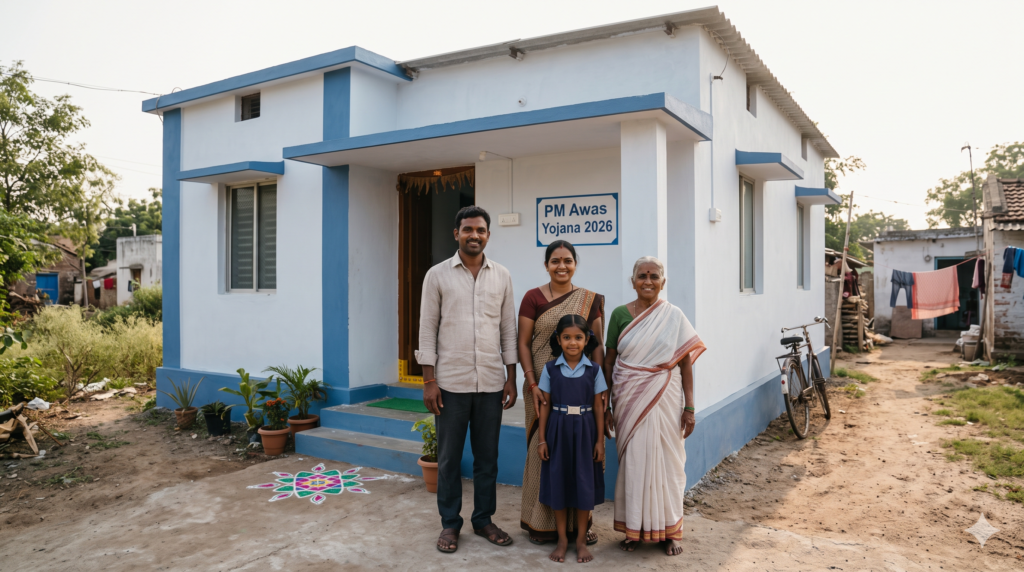
PM Awas Yojana 2026: Eligibility, Documents and How to Apply Online
Table of Contents
Owning a permanent house is an important goal for many Indian families. However, rising construction costs, limited income, and difficulties in arranging housing finance can make it challenging for low-income households to build or purchase a home.
The Pradhan Mantri Awas Yojana (PMAY) is a Government of India housing programme intended to help eligible families access affordable housing. If you are searching for PM Awas Yojana 2026, the first step is to identify whether you need assistance under the urban or rural housing programme.
PMAY has two main branches: Pradhan Mantri Awas Yojana–Urban (PMAY-U), including its current second phase, PMAY-U 2.0, and Pradhan Mantri Awas Yojana–Gramin (PMAY-G). Each follows different eligibility rules and administrative procedures.
In this guide, you will learn about the eligibility criteria, income limits, required documents, application methods, beneficiary information, and ways to avoid common mistakes. You will also find official government links to help you verify the latest information before submitting an application.
Important: Meeting the general eligibility conditions does not guarantee approval or financial assistance. The concerned authorities must verify your information and determine eligibility under the applicable programme.
What Is PM Awas Yojana?
Pradhan Mantri Awas Yojana is a government housing initiative designed to improve access to permanent housing for eligible households.
The programme operates through separate urban and rural arrangements because housing needs, beneficiary identification, and implementation methods differ between towns, cities, and villages.
1. PMAY-U 2.0: Urban Housing Scheme
PMAY-U 2.0 is the second phase of the urban housing mission. It was launched with effect from 1 September 2024 and aims to support one crore additional eligible urban families over five years.
The scheme has four components:
- Beneficiary-Led Construction (BLC): Assistance for eligible families to construct a house on their own available land, subject to the scheme conditions.
- Affordable Housing in Partnership (AHP): Affordable ownership housing developed through eligible public or private partnerships.
- Affordable Rental Housing (ARH): Affordable rental housing for eligible groups, including people who need rental accommodation rather than immediate home ownership.
- Interest Subsidy Scheme (ISS): Interest subsidy on eligible home loans, subject to the applicable conditions.
These components serve different housing needs. An applicant should choose the relevant route rather than assuming every applicant receives the same type of assistance.
Official website: PMAY Urban
2. PMAY-G: Rural Housing Scheme
PMAY-G, or Pradhan Mantri Awas Yojana–Gramin, focuses on eligible rural households that need permanent housing.
Beneficiary identification and verification follow rural housing programme rules. Depending on the applicable process, information may be collected through an authorised survey, local verification, and the relevant government records.
The AwaasPlus 2024 section of the official PMAY-G website provides survey information, application guidance, and related resources. However, the availability of a survey tool does not automatically mean every person can apply for assistance at any time.
Rural applicants should check the current instructions and consult their Gram Panchayat or the responsible rural development office when they need help understanding their eligibility.
Official website: PMAY-G
Key Benefits and Purpose of PM Awas Yojana
The main purpose of the scheme is to help eligible families obtain suitable housing through the applicable government-supported process.
The actual benefit depends on the programme, the applicant’s circumstances, the selected component, and the approval granted by the authorities.
Major benefits and objectives include:
- Support for permanent housing: Eligible beneficiaries may receive assistance for constructing or obtaining a permanent house.
- Improved living conditions: The programme aims to expand access to safer housing and basic household facilities.
- Affordable ownership options: Certain urban components support eligible families who want to construct or purchase a home.
- Housing loan assistance: Eligible borrowers may receive interest subsidy under PMAY-U 2.0’s Interest Subsidy Scheme, subject to the rules.
- Rental housing options: The urban programme includes an affordable rental housing component for eligible groups.
- Support for vulnerable households: The programme gives attention to disadvantaged groups and households with particular housing needs.
- Better housing security: A permanent home can help families achieve greater stability, although the scheme does not guarantee approval to every applicant.
The form of assistance matters. A family seeking help to construct a house on its own land may need a different application route from a family seeking an eligible housing loan subsidy.
Before proceeding, identify the type of housing support you need and confirm which component is available in your state or area.
PM Awas Yojana 2026 Eligibility Criteria
Eligibility is one of the most important parts of the application process. Applicants should not rely on social media posts or general statements that everyone without a house automatically qualifies.
PMAY-U 2.0 eligibility
Under the published PMAY-U 2.0 guidelines, eligible urban households must satisfy the relevant income and housing conditions.
The principal conditions include:
- The family must fall within the applicable Economically Weaker Section (EWS), Low Income Group (LIG), or Middle Income Group (MIG) category.
- The family must meet the scheme’s requirement concerning ownership of a permanent, or pucca, house anywhere in India.
- The applicant must satisfy the conditions for the selected scheme component.
- The family must comply with applicable restrictions relating to benefits received under other government housing schemes.
- The application must pass the required verification and approval process.
The scheme guidelines also state that a beneficiary who has been allotted a house under a Central, State/UT, or local government housing scheme during the preceding 20 years is not eligible to seek a benefit under PMAY-U 2.0. Applicants should check the exact applicability of this condition before submitting an application.
PMAY-U 2.0 income limits
The standard income categories in the published guidelines are:
| Category | Annual household income |
|---|---|
| EWS | Up to ₹3 lakh |
| LIG | Above ₹3 lakh and up to ₹6 lakh |
| MIG | Above ₹6 lakh and up to ₹9 lakh |
These are household income categories, not simply the salary limits of an individual applicant. State-specific provisions and the requirements of the selected component should also be checked.
For example, a household earning ₹5 lakh per year may fall within the LIG income category. This does not, by itself, confirm eligibility: the other housing, benefit-history, and application conditions must also be met.
PMAY-G eligibility
The rural housing programme uses a different beneficiary-identification process.
An applicant’s eligibility may depend on factors such as:
- The household’s housing condition.
- The household’s inclusion in the applicable beneficiary identification or survey process.
- Information collected through authorised rural housing surveys.
- Verification by the responsible local and government authorities.
- The applicable programme guidelines and beneficiary selection procedures.
Do not assume that the urban income categories listed above automatically apply to PMAY-G. Rural applicants should refer to the current PMAY-G instructions and the records used by the responsible authorities.
Who may not qualify?
An applicant may be ineligible if they fail to meet the relevant income or housing requirements, are excluded under applicable scheme restrictions, or do not satisfy the verification conditions.
Owning a permanent house, receiving a disqualifying housing benefit in the past, or providing incorrect information may affect eligibility.
The final decision rests with the competent authority under the relevant scheme.
Documents Required for PM Awas Yojana
Preparing the necessary paperwork in advance can reduce delays. The exact checklist depends on whether you are applying under PMAY-U 2.0 or being considered under PMAY-G.
Common documents and information to prepare
Keep the following available where applicable:
- Aadhaar card or other identification accepted under the applicable process.
- Proof of identity and personal details.
- Proof of residence or address, where required.
- Mobile number for communication and verification.
- Bank account details and supporting bank documents.
- Income certificate or other accepted income evidence, where required.
- Details of family members.
- Information about existing house ownership.
- Category certificate, if claiming a relevant category-based benefit.
- Land ownership or other acceptable land-related documents for construction assistance.
- Property or housing details for the selected component.
- Any declaration or undertaking requested by the official application process.
Documents that may depend on your situation
For PMAY-U 2.0: Applicants may need additional information about household income, family composition, existing housing, land, and the selected scheme component. Applicants seeking interest subsidy should also check the lender’s requirements and the scheme’s loan-related conditions.
For PMAY-G: The required information may be collected through the authorised survey and verification process. Aadhaar-related e-KYC and other details may be required under the current instructions.
Do not assume that every document in the list is mandatory for every applicant. Follow the checklist issued for your specific component and location.
Before submitting anything, check that names, dates of birth, addresses, and other details match the relevant records. Keep copies of the documents and any acknowledgement generated by the official process.
How to Apply Online for PM Awas Yojana 2026
The application procedure differs between urban and rural housing. Follow the relevant instructions rather than using a website that claims to handle every type of PMAY application.
How to apply under PMAY-U 2.0
Step 1: Open the official PMAY Urban website
Visit pmay-urban.gov.in. Look for the PMAY-U 2.0 section and read the latest scheme guidelines and application instructions.
Step 2: Check your eligibility
Review the income category, house ownership conditions, previous housing benefits, and other requirements.
Identify whether you are seeking construction assistance, an affordable ownership option, rental housing, or interest subsidy. The appropriate route depends on your circumstances.
Step 3: Find the current application facility
Use the official scheme website to identify the applicable application portal or the authorised application process for your area.
If the online facility directs applicants to a local urban body, municipal office, housing authority, or participating lending institution, follow that instruction. Do not assume that all four components use an identical application form.
Step 4: Enter the requested information
Complete the fields shown in the authorised application facility. These may request details such as:
- Applicant and family information.
- Aadhaar or other accepted identification details.
- Household income.
- Existing house ownership.
- Address and location.
- Bank details, where required.
- The preferred scheme component.
- Land, property, or loan details relevant to the application.
Enter accurate information and check the form before continuing.
Step 5: Upload documents or complete verification
Provide the documents requested by the authorised process. If Aadhaar verification, an undertaking, or additional documentation is required, complete it using the prescribed method.
Never share an Aadhaar OTP, bank OTP, or other confidential authentication code with an unauthorised person.
Step 6: Submit the application
Review all details carefully. Submit the form only after confirming that the information is accurate and that you are using the correct official facility.
If an acknowledgement number or application reference is generated, save it securely.
Step 7: Complete any further checks
An online submission is not the same as final approval. Authorities or participating institutions may need to verify the household, property, income, loan, or other relevant information.
Respond to official requests for clarification and follow the instructions provided for the selected component.
How to apply under PMAY-G
Rural applicants should use the official rural housing website and follow the applicable beneficiary identification or survey procedure.
Step 1: Visit the PMAY-G portal
Open pmayg.nic.in and look for current notices, beneficiary information, and survey instructions.
Step 2: Check the current survey or identification process
The official portal includes an AwaasPlus 2024 section containing information about self-surveys, assisted surveys, and related tools. Check whether the relevant process is currently available and applicable to your household.
Step 3: Follow the authorised survey instructions
If a self-survey or assisted survey is permitted, use the official instructions and required application. Complete the requested household and housing details accurately.
Where assistance is necessary, contact the Gram Panchayat or responsible rural development official.
Step 4: Complete identity verification
Follow the current e-KYC and identity verification requirements. Use only the authorised app or procedure identified by the official website.
Step 5: Wait for verification
The information submitted may need to be checked against applicable records and verified by the responsible authorities.
Step 6: Check the official beneficiary information
Use the PMAY-G portal or the responsible local office to determine whether your household appears in the relevant records and whether further action is required.
A self-survey does not guarantee that a household will be selected for assistance.
How to Check PM Awas Yojana Application Status
The appropriate status-checking method depends on your scheme and application stage.
For urban applicants
Visit the official PMAY Urban website and locate the relevant application, beneficiary, or scheme information facility.
If your application was submitted through an authorised local body or a participating lending institution, that organisation may be the appropriate place to request an update.
Keep your application reference number and the details used during submission available. Enter personal information only on a verified government portal or provide it through an authorised office.
For rural applicants
Visit pmayg.nic.in and look for the relevant beneficiary or reporting facilities. You may also contact your Gram Panchayat or the responsible rural development office for assistance.
A survey record, beneficiary-list entry, sanction, and release of financial assistance are different stages. Confirm what the displayed status actually means before assuming that funds have been approved or released.
If your name does not appear, ask the responsible office whether your details have been entered, whether verification remains pending, and whether any correction or additional step is permitted.
Fees, Charges and Processing Time
Applicants should be careful about claims involving application fees, guaranteed approval, and fixed payment dates.
Is there an application fee?
Do not assume that a third-party website’s service charge is an official government fee. Check the relevant PMAY guidelines and the authorised application process to determine whether any charge applies to your particular service.
If you use a Common Service Centre (CSC), ask for a clear explanation of any service charge and request a receipt. A service charge, where applicable, is different from a government scheme fee.
How long does approval take?
There is no single processing time that can safely be promised for every PMAY applicant.
The time required may depend on factors such as:
- Verification of household and identity details.
- Availability of the required documents.
- Local authority inspections or verification.
- Beneficiary selection and approval.
- Availability of an applicable housing project.
- Bank or housing finance processing under the relevant urban component.
- Administrative procedures for releasing approved assistance.
If your application remains pending, contact the authority responsible for your application. Ask whether verification is incomplete, additional documents are required, or the application is awaiting a decision.
When is financial assistance released?
Financial assistance is subject to eligibility, approval, and the applicable programme rules. Its amount, payment conditions, and release stages can vary by component and category.
Do not make construction commitments or take a loan based on an assumption that assistance will arrive by a particular date. Confirm the approval and payment conditions with the responsible authority first.
Common PM Awas Yojana Problems and Their Solutions
Applicants may face difficulties when entering personal information, completing verification, or locating their records. The right solution depends on the issue and the application stage.
1. Aadhaar details do not match
A mismatch between Aadhaar details and the information entered in an application can prevent successful verification.
What to do: Check the spelling of your name, date of birth, and other requested details. Correct errors through the authorised process. If your official records themselves contain incorrect information, arrange the necessary correction before trying again.
2. OTP is not received
An OTP may be delayed because of network problems, an incorrect mobile number, or other verification issues.
What to do: Check your mobile network and confirm that the number entered is correct. Wait before requesting another OTP and follow the portal’s instructions. Never disclose an OTP to someone claiming they can guarantee your application approval.
3. The application cannot be submitted
The form may contain missing fields, invalid entries, or documents that do not meet the specified requirements.
What to do: Review the form carefully, check the accepted document formats and file-size limits, and correct any highlighted errors. If the problem continues, contact the official portal’s support channel or the responsible local authority.
4. The applicant’s name is missing from the beneficiary list
A missing name does not necessarily establish that the person is permanently ineligible. The household may not have been selected, the records may require verification, or the person may be checking the wrong programme or list.
What to do: Confirm whether you are checking PMAY-U or PMAY-G. Contact the relevant urban or rural authority to ask whether your details are recorded and what correction or review procedure, if any, is available.
5. The application remains pending
Applications can remain pending while the responsible authority checks documents, housing conditions, or other eligibility requirements.
What to do: Keep your reference number and acknowledgement available. Ask the responsible office which stage is incomplete and whether any action is required from you. Avoid submitting multiple applications for the same benefit without official guidance.
6. Someone asks for money to guarantee approval
Be cautious if an agent promises a confirmed house, guaranteed selection, or faster approval in exchange for an unofficial payment.
What to do: Verify the process through the official PMAY website or the responsible government office. Do not share bank credentials, OTPs, or unnecessary personal information with unknown individuals. Keep receipts and relevant communications if you need to report suspected fraud.
Important Things to Remember Before Applying
Before submitting your PM Awas Yojana application, use this checklist to avoid preventable errors.
- Confirm whether your household falls under the urban or rural programme.
- Read the latest official guidelines for your selected component.
- Check the eligibility rules, including income and existing house ownership.
- Keep the required documents ready in the accepted format.
- Enter accurate information about your family, income, property, and bank details.
- Use only official government websites or authorised application channels.
- Save your acknowledgement number and any official communication.
- Follow up with the relevant authority if verification or approval is pending.
- Do not assume that submitting a form guarantees financial assistance.
- Verify the current application window and local implementation instructions before relying on older online guides.
Official websites for applicants
The following government websites are useful starting points:
- PMAY Urban: https://pmay-urban.gov.in/
- PMAY-G: https://pmayg.nic.in/
- PMAY-U 2.0 guidelines: https://pmay-urban.gov.in/index.php/pmay-u-2.0-guidelines
- AwaasPlus survey information: https://pmayg.nic.in/infoapp.html
Check these sources for the latest instructions rather than relying solely on old application tutorials or unofficial websites.
Conclusion
PM Awas Yojana provides a government-supported route to housing assistance for eligible Indian households, but the correct application process depends on where you live and the type of support you need.
Urban applicants should review PMAY-U 2.0, check the income and housing conditions, and identify the relevant application component. Rural applicants should consult the PMAY-G portal and follow the applicable beneficiary identification and verification procedure.
Prepare your documents, provide accurate information, and retain your acknowledgement details. Most importantly, confirm the current rules through the official government website or responsible local authority before taking any financial decision.
14. FAQ SECTION
1. What is PM Awas Yojana 2026?
PM Awas Yojana is a government housing programme for eligible Indian households. It includes PMAY-U 2.0 for urban areas and PMAY-G for rural areas, with separate eligibility and implementation rules.
2. Who is eligible for PM Awas Yojana 2026?
Eligibility depends on the relevant scheme. Under PMAY-U 2.0, applicants must satisfy the applicable income, housing ownership, previous-benefit, and other conditions. Rural applicants must follow the PMAY-G beneficiary identification process.
3. What is the income limit for PMAY-U 2.0?
The published urban guidelines define EWS as annual household income up to ₹3 lakh, LIG as above ₹3 lakh and up to ₹6 lakh, and MIG as above ₹6 lakh and up to ₹9 lakh. Other eligibility conditions also apply.
4. Which documents are required for PM Awas Yojana?
Depending on the application, documents may include Aadhaar or other accepted identification, income evidence, bank details, address information, family details, and land or property documents. Follow the checklist for your particular scheme component.
5. How can I apply for PM Awas Yojana online?
For urban housing, start at pmay-urban.gov.in. For rural housing, visit pmayg.nic.in and follow the applicable survey or beneficiary identification instructions. The process varies by programme.
6. Can I apply for PMAY if I already own a house?
PMAY-U 2.0 generally requires the beneficiary family not to own a pucca house anywhere in India, subject to the specific provisions of the guidelines. Rural eligibility follows its own rules. Check the applicable conditions before applying.
7. How can I check my PM Awas Yojana beneficiary status?
Use the relevant official urban or rural portal and its available beneficiary or application facilities. You can also contact the responsible municipal authority, Gram Panchayat, or other implementing office, depending on your scheme.
8. Is PM Awas Yojana approval guaranteed after applying?
No. Submission does not guarantee approval or payment. The application must satisfy the relevant eligibility conditions and complete the required verification and approval process.
15. INTERNAL LINK SUGGESTIONS
These are suggested article topics and anchor texts for Adhikar Kendra. Publish them only when the corresponding articles are available; no existing URLs are assumed.
| Suggested article topic | Recommended anchor text |
|---|---|
| How to Apply for an Aadhaar Card | Aadhaar card application process |
| How to Apply for an Income Certificate | documents required for an income certificate |
| How to Check Government Scheme Beneficiary Lists | how to check a government beneficiary list |
These links would help readers understand identity verification, income documentation, and beneficiary records without distracting from the main housing application.
16. VERIFIED OFFICIAL SOURCES

1. Ministry of Housing and Urban Affairs — PMAY Urban
Official portal for the urban housing mission, scheme updates, guidelines, and related resources.
PMAY-Urban

2. PMAY-U 2.0 Scheme Guidelines
Official scheme guidelines covering eligibility, income categories, components, and implementation requirements.
PMAY-Urban
+1

3. Ministry of Rural Development — PMAY-G
Official rural housing portal for beneficiary information, programme resources, and rural survey instructions.
Pradhan Mantri Awas Yojana Gramin
+1

4. Press Information Bureau — PMAY-U 2.0 announcement
Government announcement explaining the objectives and broad structure of the urban housing programme.
Read the official announcement
Press Information Bureau
Editorial note: Government application facilities, availability, and instructions may change. Recheck the official portals immediately before publication, particularly for any claim about a 2026 application deadline, current application availability, processing time, or payment schedule.