
Government Scholarships for Students in India: Eligibility, Benefits and How to Apply
Table of Contents
Education can open doors to better career opportunities, but school fees, college tuition, books, accommodation, and other academic expenses can put pressure on families. Government scholarships can help eligible students continue their studies by providing financial assistance under specific schemes.
There are several government scholarships for students in India, including schemes for school students, college students, postgraduate students, girls pursuing technical education, students from eligible social categories, and students who meet particular merit or financial criteria.
However, not every scholarship is available to every student. Each scheme has its own eligibility conditions, benefits, documents, application period, and verification procedure. Understanding these differences is the first step towards choosing a suitable scholarship.
This guide explains major government scholarships for students for the 2026–27 academic year, how to check eligibility, where to find official information, and how to apply. It also explains why students should verify deadlines rather than depend on old social media posts or outdated articles.
You can start by visiting the official National Scholarship Portal, which lists participating central government schemes and their application details.
What Are Government Scholarships for Students?
Government scholarships are financial assistance programmes provided or supported by government departments and authorised public institutions. They are designed to support eligible students according to the purpose and conditions of each scheme.
Some government scholarships for students are based mainly on academic merit. Others consider family income, social category, disability, geographical location, course, or special circumstances.
Scholarship assistance may cover a fixed annual amount, education-related expenses, or other benefits specified in the scheme guidelines. The amount and permitted use of the assistance depend on the individual programme.
Students may find opportunities through central government departments, state governments, educational authorities, universities, and technical education bodies. Not all scholarships use the same application portal.
The National Scholarship Portal is an important starting point for many government scholarships for students, but some state scholarships and institution-specific programmes require applications through separate official websites.
Before applying, read the official guidelines carefully. A scholarship listing is not a guarantee of selection, and submitting an application does not automatically establish eligibility or entitlement to payment.
Major Government Scholarships for Students in India
The following schemes are useful starting points for students exploring financial assistance. Their availability, eligibility, and deadlines can change, so confirm the current academic year’s details through the official links.
1. PM-USP Central Sector Scheme of Scholarship for College and University Students
The Pradhan Mantri Uchchatar Shiksha Protsahan (PM-USP) Central Sector Scheme of Scholarship for College and University Students supports eligible meritorious students pursuing higher education.
It is intended to help qualifying students meet part of their day-to-day expenses while studying. Eligibility is subject to academic performance, family income, course and institution requirements, and other conditions specified in the official guidelines.
This scheme may be relevant to students moving from Class 12 into eligible college or university courses.
Among the government scholarships for students, this is an important option for those who perform well academically and meet the scheme’s other conditions.
Official information: National Scholarship Portal and Ministry of Education.
2. National Means-cum-Merit Scholarship Scheme (NMMSS)
The National Means-cum-Merit Scholarship Scheme aims to support meritorious students from economically weaker sections and encourage them to continue secondary education.
The scheme is intended for eligible students selected under the prescribed process, with scholarship support continuing subject to the applicable renewal conditions.
It is particularly relevant to families looking for government scholarships for students at the school level. However, students must check the official selection requirements, eligible school conditions, and academic criteria.
For the 2026–27 academic year, the application and verification timeline should be checked carefully because official notices can revise dates. Do not rely on an old deadline from a previous academic year.
Official information: National Scholarship Portal and Ministry of Education.
3. PM YASASVI Scholarship Scheme
PM Young Achievers Scholarship Award Scheme for Vibrant India, commonly called PM YASASVI, supports eligible students from specified communities, including OBC, EBC, and DNT groups, under its different components.
The scheme includes education-related support at school and college levels. Eligibility and benefits depend on the particular component, the applicant’s circumstances, and the official rules.
Students should not assume that every PM YASASVI component has identical eligibility or deadlines. For example, the official National Scholarship Portal lists separate top-class education schemes for schools and colleges.
For eligible applicants, PM YASASVI is among the government scholarships for students worth checking when searching for support linked to specified community and education criteria.
Official information: National Scholarship Portal and Department of Social Justice and Empowerment.
4. Ishan Uday Special Scholarship Scheme for the North Eastern Region
Ishan Uday is a scholarship scheme for eligible students from the North Eastern Region pursuing qualifying higher education.
It may be relevant to students from eligible states who meet the scheme’s academic, income, course, and other requirements.
Students considering government scholarships for students should check whether their state, institution, and course qualify. The scholarship is not automatically available to every student from the region.
The current National Scholarship Portal listing should be used to confirm the application window and detailed guidelines for the academic year.
Official information: National Scholarship Portal and University Grants Commission.
5. National Scholarship for Post Graduate Studies
Students planning postgraduate study may wish to check the National Scholarship for Post Graduate Studies listed through the University Grants Commission and National Scholarship Portal.
The scheme has its own eligibility requirements, including conditions related to the course and applicant. Students should consult the current official guidelines rather than assume that all postgraduate students can apply.
For graduates looking for government scholarships for students, this scheme may be relevant if they are entering an eligible postgraduate programme and satisfy the prescribed requirements.
Check the official listing for the academic year, the application deadline, and any restrictions on eligibility.
Official information: National Scholarship Portal and UGC Student Corner.
6. AICTE Pragati Scholarship Scheme for Girl Students
The AICTE Pragati Scholarship Scheme supports eligible girl students pursuing approved technical education programmes, subject to the applicable rules.
The National Scholarship Portal lists separate Pragati options for technical degree and diploma students. Applicants should check the relevant category and ensure that their institution and course meet the scheme conditions.
For girls exploring government scholarships for students in technical education, Pragati is worth reviewing alongside other available education support programmes.
The application process, permitted benefits, selection criteria, and deadline should be confirmed through the official scheme details.
Official information: National Scholarship Portal and AICTE.
7. AICTE Saksham Scholarship Scheme
The AICTE Saksham Scholarship Scheme is intended for eligible specially abled students pursuing qualifying technical diploma or degree programmes.
The National Scholarship Portal lists separate Saksham options for technical degree and diploma students. The conditions and application requirements should be checked against the relevant scheme guidelines.
Students with disabilities who are exploring government scholarships for students should review the current eligibility requirements, including any required disability documentation and institutional conditions.
Do not assume that every technical course or institution qualifies. Confirm that the programme and the applicant satisfy the official rules.
Official information: National Scholarship Portal and AICTE.
8. AICTE Swanath Scholarship Scheme
The AICTE Swanath Scholarship Scheme supports eligible students who fall within the special categories defined by the scheme. The current portal lists technical diploma and degree options.
Because eligibility is specific, applicants should read the latest official guidelines and confirm whether their personal circumstances, course, and institution qualify.
For students comparing government scholarships for students in technical education, Swanath may be worth investigating alongside Pragati and Saksham.
Check the official scheme listing for the current application window and the documents required.
Official information: National Scholarship Portal.
9. Central Sector Scheme of Top Class Education for SC Students
This scheme supports eligible Scheduled Caste students pursuing qualifying higher education, subject to the programme’s requirements.
Applicants may need to satisfy criteria relating to the institution, course, family income, category documentation, and other conditions specified in the current guidelines.
Eligible students considering government scholarships for students should compare this scheme with other support available through their state and institution.
Before applying, confirm the current eligibility criteria and whether the course and institution are included under the scheme.
Official information: National Scholarship Portal and Department of Social Justice and Empowerment.
10. Scholarships for students with disabilities
The National Scholarship Portal lists several schemes for eligible students with disabilities, including pre-matric, post-matric, and top-class education support.
The appropriate scheme depends on the student’s educational level and other eligibility conditions. Applicants should read the specific requirements and prepare any disability-related documentation requested.
These are important government scholarships for students who may need financial support to continue their education, but the scheme rules determine who can receive assistance.
The portal’s current announcements also specify additional steps for certain applicants with disabilities, including UDID-related requirements where applicable. Check the latest instructions before submitting an application.
Official information: National Scholarship Portal.
How to Choose the Right Scholarship
There is no single scholarship that is best for every student. The right choice depends on your education level, academic record, family circumstances, course, institution, and other conditions.
When comparing government scholarships for students, start with these questions:
- Are you studying in school, college, a technical diploma programme, or postgraduate education?
- Does the scheme cover your course and institution?
- Is there an academic performance requirement?
- Is there a family income limit?
- Does the scheme require a caste, disability, residence, or other certificate?
- Is the application currently open?
- What are the renewal conditions if you receive the scholarship?
Make a shortlist of schemes for which you appear eligible. Then read the official guidelines for each one before applying.
Do not select a scholarship solely because a website advertises a high benefit amount. A scheme with a large advertised benefit is not useful if you do not meet its eligibility conditions.
How to Apply for Government Scholarships Online
Many central schemes use the National Scholarship Portal, while some state scholarships use separate portals. The correct process depends on the scheme.
For government scholarships for students listed on the National Scholarship Portal, the general process is as follows.
Step 1: Open the official portal
Visit scholarships.gov.in and select the relevant academic year.
Use the official government website rather than an unofficial page offering paid registration or guaranteed approval.
Step 2: Complete One Time Registration
The National Scholarship Portal uses One Time Registration (OTR) for covered scholarship applications. Follow the current official OTR instructions and save your registration details securely.
OTR registration is a separate step; it does not mean you have applied for a particular scholarship.
Step 3: Find the relevant scheme
Search the scholarship listings and select a scheme that matches your education level and circumstances.
Students looking for government scholarships for students should review the detailed scheme specifications, not just the title.
Step 4: Check eligibility and deadlines
Read the current guidelines. Confirm the course, institution, academic criteria, income requirements, category conditions, and application deadline.
Step 5: Prepare the required documents
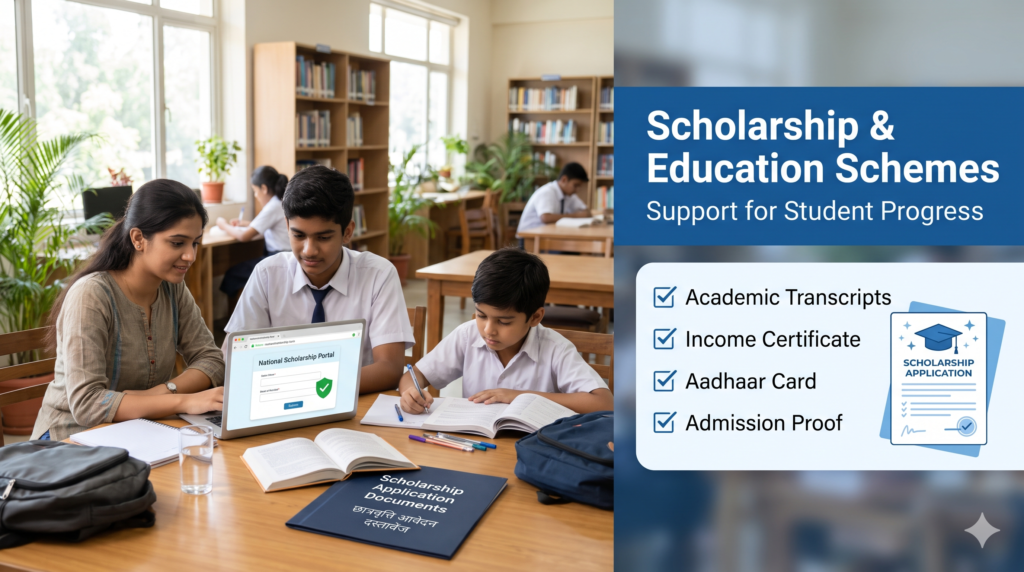
Prepare the documents specified by the scheme. These may include academic records, identity information, income or category certificates, bank details, and other supporting records, depending on the scheme.
Step 6: Complete the application
Fill in the form accurately. Check your name, course, institution, academic details, and other information before submitting it.
Step 7: Submit and save the acknowledgement
Follow the final submission steps and save the application reference or acknowledgement if provided.
Step 8: Follow verification
Some applications require verification by the institution and relevant government authorities. Follow up with the institution if an action is pending.
The government scholarships for students application process is not complete merely because a form has been submitted. Approval and payment depend on the scheme’s verification and sanction procedures.
For a detailed guide, read our article on National Scholarship Portal: How to Apply Online.
Documents Commonly Required for Scholarship Applications
The document list varies from one scheme to another. Students should use the official guidelines as the final checklist.
Commonly requested information or documents may include:
- Student identity and registration details
- Academic marksheets or examination records
- Current admission or enrolment information
- Institution and course details
- Income certificate, if required
- Caste or community certificate, if applicable
- Disability certificate or UDID information, where applicable
- Bank account details for eligible payments
- Photograph or other declarations requested by the scheme
Not every applicant needs every document. The authority may ask for additional evidence based on the scheme and the applicant’s circumstances.
If a scheme requires an income certificate, read our Income Certificate Online Apply guide. If a caste certificate is required, see Caste Certificate Online Apply.
When applying for government scholarships for students, ensure that uploaded documents are readable and that the details match your application. Incorrect or incomplete information can delay verification or affect eligibility.
Scholarship Deadlines for 2026–27
Scholarship deadlines differ across schemes, and application windows may be revised by official notices.
For the 2026–27 academic year, the National Scholarship Portal lists several schemes with student application deadlines of 31 October 2026, while the PM YASASVI Top Class Education in Schools listing shows a student deadline of 30 November 2026. These dates apply to the specific scheme listings and must not be treated as a universal deadline.
Before applying for government scholarships for students, check:
- The student application closing date.
- The institution verification deadline.
- Any district, state, or departmental verification deadline.
- Whether the scheme has published an official extension.
- Whether you need to complete a fresh or renewal application.
Apply as early as possible. A student may miss an opportunity by waiting until the last day or by assuming that all schemes close together.
How to Check Scholarship Status and Payment
After submitting an application, use the relevant official portal to check its progress.
The application may need verification by the institution and government authorities. A submitted application is not the same as an approved scholarship.
If your application shows that an action is pending, read the status message and contact the relevant institution or authority where necessary.
For government scholarships for students, payment may depend on successful verification, sanction, and the payment process specified by the scheme. Use only official payment-tracking services and follow the scheme’s instructions.
Do not pay an agent who claims they can release a scholarship payment or guarantee selection. Keep your application reference and acknowledgement details available for official enquiries.
Can Students Apply for More Than One Scholarship?
The answer depends on the applicable rules.
For the 2026–27 academic year, the National Scholarship Portal announcement says students may apply for one merit-based scholarship scheme and one or more welfare-based scholarship schemes, subject to meeting the respective eligibility criteria. Individual scheme rules still apply.
Students considering multiple government scholarships for students should read the guidelines carefully. Some schemes restrict receiving another scholarship for the same course or period, and students may need to disclose other financial assistance.
Never assume that every combination is allowed. If two schemes appear to overlap, contact the relevant scholarship authority or institution before accepting benefits.
Common Mistakes to Avoid
When applying for government scholarships for students, avoid these common problems:
- Applying without checking the full eligibility criteria.
- Missing the deadline.
- Entering incorrect academic or personal details.
- Uploading unclear or incomplete documents.
- Ignoring institution verification.
- Creating duplicate registration records where the portal requires a single OTR.
- Assuming that submission guarantees approval.
- Paying an unofficial agent for a scholarship.
- Relying on outdated benefit amounts or application dates.
Keep a copy of the scheme guidelines and your application acknowledgement. Check the official portal regularly for updates.
Need Help Finding a Scholarship?
Choosing between different government scholarships for students can be confusing, particularly when schemes have different eligibility conditions and application portals.
You can contact Adhikar Kendra for informational assistance with understanding the application process and identifying which official details to check.
🟢 Get Help on WhatsApp: +91 9051725477
Adhikar Kendra is an independent information service, not a government department. Scholarship eligibility, approval, and payment are determined by the relevant authorities. Do not share your password, OTP, or sensitive personal documents with unknown individuals.
Frequently Asked Questions (FAQs)
1. What are the major government scholarships for students in India?
Examples include PM-USP Central Sector Scholarship, National Means-cum-Merit Scholarship Scheme, PM YASASVI, Ishan Uday, National Scholarship for Post Graduate Studies, and selected AICTE schemes. Eligibility differs by programme.
2. Where can I find government scholarship applications?
Many central schemes are listed on the National Scholarship Portal. Some state and institution scholarships require applications through separate official websites.
3. Can school students apply for scholarships?
Yes, some schemes are designed for eligible school students. Applicants must meet the specific scheme’s class, academic, income, and other conditions.
4. Are scholarships available for college students?
Yes. Certain schemes support eligible undergraduate, technical, and postgraduate students. Check the current scheme guidelines to confirm whether your course and institution qualify.
5. What documents are needed for a scholarship?
Depending on the scheme, students may need academic records, identity details, income or category certificates, bank information, and other supporting documents. Follow the official document checklist.
6. What is the last date for government scholarships in 2026–27?
There is no single deadline for all schemes. Check the specific scholarship listing on the official portal and look for any official extension.
7. Does applying guarantee that I will receive a scholarship?
No. Applications must meet the eligibility conditions and complete the required verification and approval process. Payment is subject to the applicable scheme rules.
8. Can I apply for more than one scholarship?
Possibly, depending on the scheme rules. The National Scholarship Portal’s 2026–27 announcement allows one merit-based scheme and one or more welfare-based schemes, subject to eligibility and the individual guidelines.
Conclusion
Government scholarships can help eligible students continue their education, but the right scheme depends on the student’s course, academic record, financial circumstances, and other eligibility conditions.
Start by exploring government scholarships for students through official sources. Compare the available schemes, read the guidelines, prepare the required documents, and submit your application before the relevant deadline.
For the 2026–27 academic year, verify all current dates and requirements on the official National Scholarship Portal. Do not assume that a deadline or benefit amount from an earlier year is still valid.
If you need help understanding the online process, you can contact Adhikar Kendra through WhatsApp.
🟢 Need Help? Contact Us on WhatsApp
Internal Links for Adhikar Kendra
- National Scholarship Portal: Online Application Guide
- Caste Certificate Online Apply
- Income Certificate Online Apply
- Aadhaar Card Correction: Name, Date of Birth and Address
- Check Government Scheme Eligibility Online
Verified Official Sources
- National Scholarship Portal — All Scholarships: https://scholarships.gov.in/All-Scholarships
- National Scholarship Portal — Students: https://scholarships.gov.in/Students
- Ministry of Education: https://www.education.gov.in/
- University Grants Commission — Student Corner: https://www.ugc.gov.in/Home/student_Corner
- Department of Social Justice and Empowerment — Schemes: https://socialjustice.gov.in/schemes
- AICTE official website: https://www.aicte-india.org/